
Achilles Tendinopathy | When it isn’t “Just Calf Pain”
Achilles tendinopathy is one of the most common load-related injuries seen in both sporting and general active populations. It is particularly prevalent in runners, field sport athletes, surf lifesavers and individuals who undertake repetitive calf loading activities such as jumping, acceleration, hill running and plyometric training. Despite this, many people still approach Achilles pain as a simple inflammatory condition requiring rest, stretching or passive treatment alone. Current evidence suggests the reality is considerably more complex.
At SurfEdge Sports Physiotherapy, Achilles tendinopathy rehabilitation is approached from a performance rehabilitation perspective. The goal is not simply to reduce pain temporarily, but to restore tendon capacity, improve lower limb function and facilitate a successful return to activity whilst minimising the risk of recurrence.
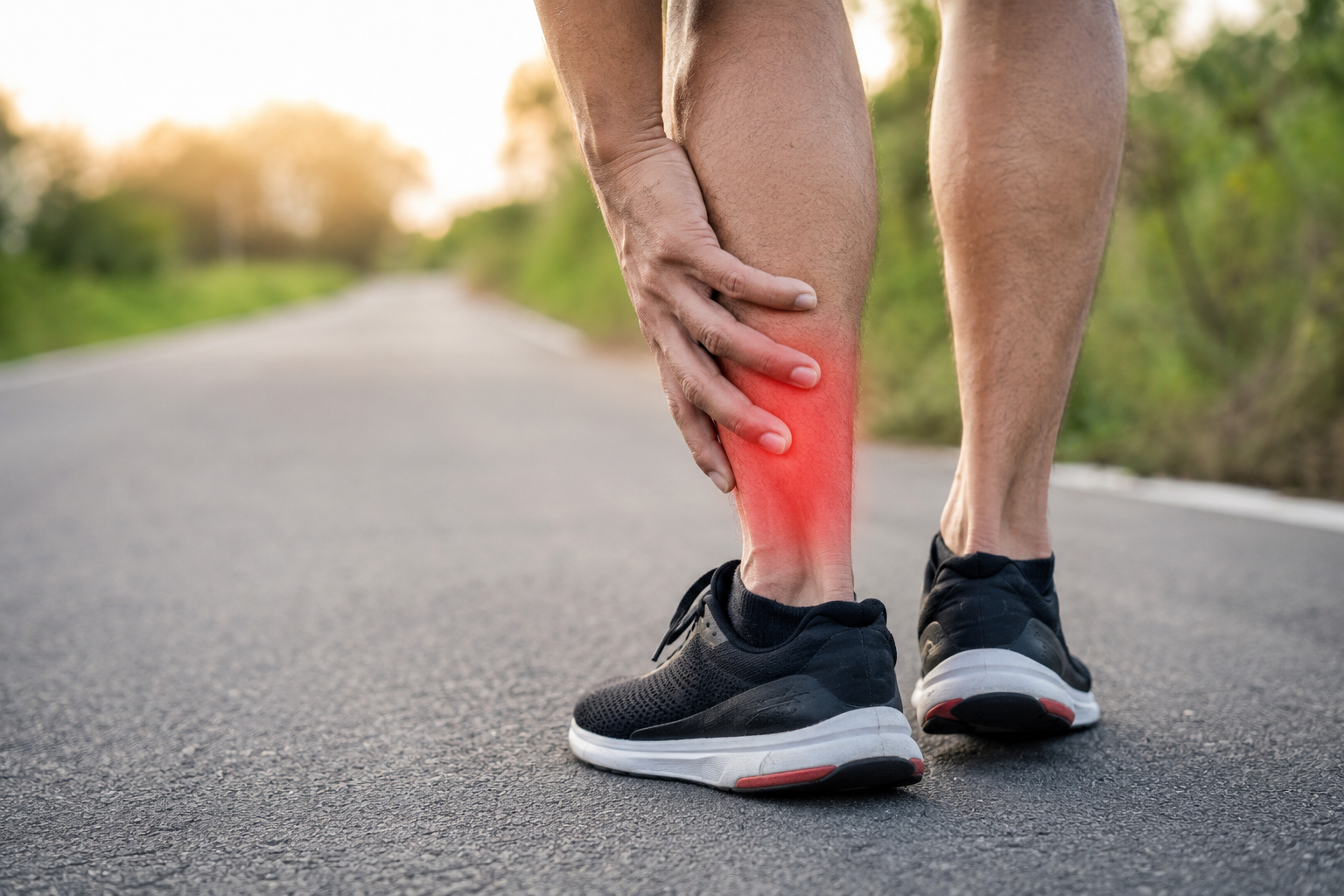
The Achilles tendon is the largest and strongest tendon in the human body, transmitting force from the gastrocnemius and soleus musculature into the calcaneus during walking, running and jumping activities. During running, the Achilles tendon is exposed to loads estimated at up to 6-8 times bodyweight. In sprinting and explosive sporting movements, these loads may increase even further. Tendons are highly adaptable structures and generally respond well to progressive loading. Problems tend to arise when the magnitude, frequency or rate of loading exceeds the tendon’s current capacity to tolerate stress.
Historically, Achilles pain was commonly referred to as “Achilles tendonitis”, implying a predominantly inflammatory process. Modern research has largely shifted away from this terminology, with “Achilles tendinopathy” now considered more appropriate. Whilst reactive inflammatory responses may occur in early presentations, persistent tendon pain is generally associated with collagen disorganisation, altered tendon structure, neovascularisation and impaired load tolerance rather than a purely inflammatory pathology.
Clinically, Achilles tendinopathy most commonly presents in two forms: mid-portion Achilles tendinopathy and insertional Achilles tendinopathy. Mid-portion presentations typically involve pain approximately 2-6 cm proximal to the tendon insertion and are more common in running populations. Insertional Achilles tendinopathy occurs directly at the tendon attachment into the calcaneus and may involve additional compressive loading mechanisms. Differentiating between these presentations is important, as management strategies may vary slightly depending on the anatomical location and irritability of the condition.
Patients commonly report morning stiffness, pain with running or jumping, tenderness on palpation and reduced tolerance to loading activities. One of the hallmark features of Achilles tendinopathy is the “warm-up phenomenon”, whereby pain may initially be present during activity, improve somewhat as exercise continues and then worsen again later following loading. Tendon thickening may also occur in more persistent presentations.
One of the more significant misconceptions surrounding Achilles tendinopathy is the belief that complete rest is the ideal management strategy. Whilst temporary load reduction is often appropriate during irritable phases, prolonged unloading may ultimately reduce tendon capacity further. Tendons require mechanical loading to stimulate adaptation. As such, many individuals enter a cycle of temporary rest, short-term symptom reduction and rapid recurrence once activity resumes. Effective rehabilitation generally involves identifying an acceptable loading window and progressively rebuilding the tendon’s tolerance to stress over time.
Load management is therefore central to successful rehabilitation. This does not necessarily mean ceasing all activity. Rather, it involves modifying aggravating loads to a level the tendon can currently tolerate whilst maintaining as much overall conditioning as possible. Factors such as running volume, sprint exposure, hill running, plyometric intensity, gym loading and recovery capacity all require consideration. Sudden spikes in training load remain one of the strongest contributing factors to tendon overload presentations.
Progressive strengthening forms a cornerstone of evidence-based Achilles rehabilitation. Heavy slow resistance training and progressive calf loading programs have demonstrated strong clinical utility in improving tendon capacity and reducing symptoms. Rehabilitation may initially utilise isometric loading strategies in highly irritable presentations before progressing toward heavier isotonic loading, unilateral strength development, plyometrics and eventually sport-specific energy storage activities. Importantly, rehabilitation should not simply focus on the tendon itself. Deficits elsewhere throughout the kinetic chain, including calf strength asymmetry, hip and trunk control deficits, reduced ankle mobility and altered lower limb biomechanics, may all contribute to excessive tendon loading.
At SurfEdge Sports Physiotherapy, rehabilitation is guided by both clinical assessment and objective performance measures where appropriate. This allows rehabilitation progressions to be based not solely on pain reduction, but also on restoration of force production, endurance, dynamic control and functional capacity. For athletes and active individuals, simply becoming “pain free” is often insufficient if underlying deficits remain unresolved.
Stretching is another area frequently misunderstood in Achilles rehabilitation. Whilst calf flexibility may be relevant in some presentations, aggressive stretching is not universally indicated and may aggravate certain conditions, particularly insertional Achilles tendinopathy where compressive loads at the tendon insertion may already be elevated. Rehabilitation should therefore be individualised rather than relying on generic online protocols.
Recovery timelines vary depending on symptom duration, tendon irritability, training demands and adherence to rehabilitation principles. Many cases improve substantially within approximately 8-12 weeks, though persistent or longstanding presentations may require a longer rehabilitation timeframe. Tendon adaptation is generally slower than muscular adaptation and requires consistency and patience.
Encouragingly, the prognosis for Achilles tendinopathy is generally favourable when managed appropriately. Early intervention often allows more rapid restoration of function and may reduce the likelihood of progression toward persistent tendon pathology. Individuals experiencing ongoing Achilles pain, morning stiffness, recurrent flare-ups or difficulty returning to activity should consider formal assessment to identify contributing factors and establish an appropriate rehabilitation strategy.
At SurfEdge Sports Physiotherapy in Maroochydore, management of Achilles tendinopathy is centred around evidence-informed rehabilitation, progressive loading principles and performance-based return to activity planning. Whether the goal is returning to recreational running, surf lifesaving competition, field sports or general exercise, rehabilitation should aim not only to reduce symptoms but to improve the tendon’s long-term capacity to tolerate load effectively.
If Achilles pain is limiting your running, training or day-to-day activity, early intervention and appropriate rehabilitation can make a significant difference to both short and long-term outcomes. At SurfEdge Sports Physiotherapy, we provide evidence-based Achilles tendinopathy rehabilitation focused on restoring tendon capacity, improving performance and facilitating a confident return to activity.
To book an appointment, contact the clinic on (07) 5444 0563 or click below