
Hip Labral Tears in Athletes
What They Are, Why They Happen, and How We Manage Them
Hip pain in athletes is rarely simple. When discomfort sits deep in the groin, lingers despite rest, or comes with clicking or catching, the hip labrum often enters the conversation.
Labral tears are increasingly recognised in both elite and everyday athletes, particularly in sports that demand repeated hip flexion, rotation, and load. Football codes, running, hockey, gymnastics, and strength training all place high demands on the hip joint. Understanding what a labral tear actually means, and what to do about it, is key to avoiding long-term issues and getting back to performance safely.
What Is the Hip Labrum?
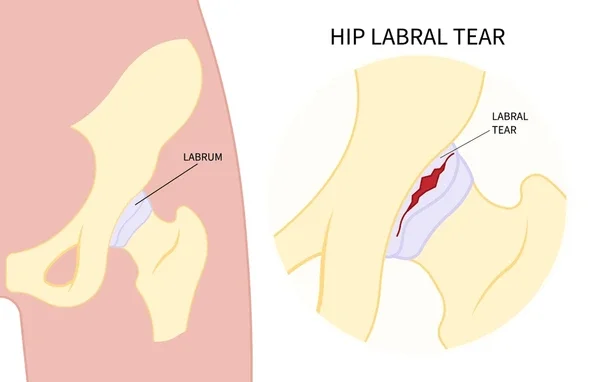
The hip joint is a ball-and-socket joint. The labrum is a ring of strong fibrocartilage that lines the rim of the hip socket, known as the acetabulum.
Its role is far more than structural padding. The labrum:
Deepens the socket to improve joint stability
Creates a suction seal that helps maintain joint pressure
Assists with load distribution across the joint
Contributes to smooth, efficient movement during high-load tasks
For athletes, this suction seal is critical. It allows force to transfer through the hip without excessive joint shear. When the labrum is compromised, the hip often feels unstable, painful, or mechanically unreliable.
Why Do Labral Tears Occur in Athletes?
Labral tears rarely happen in isolation. In most athletes, they develop due to a combination of anatomy, training load, and movement demands over time.
Underlying Hip Structure
Many athletes with labral tears have some degree of femoroacetabular impingement, commonly referred to as FAI.
There are two main types:
Cam morphology, where extra bone on the femoral neck causes abnormal contact with the socket during hip flexion
Pincer morphology, where excessive socket coverage leads to repeated compression of the labrum
These shapes are common in athletic populations and often develop during adolescence. On their own they are not necessarily problematic, but when combined with high training loads they significantly increase stress on the labrum.
Repetitive Sporting Load
Sports that involve:
Repeated deep hip flexion
Rotational loading under fatigue
Rapid direction changes
Long periods in compressed positions
place ongoing strain on the labrum. Over time, this can lead to fraying, degeneration, or tearing, particularly if training loads increase faster than tissue capacity can adapt.
Acute Injury
Less commonly, labral tears occur after a single traumatic event such as a fall, collision, or sudden twist. This is more typical in contact sports but can occur in any athlete.
Hypermobility and Reduced Stability
Athletes with naturally high mobility often rely heavily on muscular and labral stability rather than bony constraint. If strength, control, or fatigue management is lacking, the labrum can be overloaded as it attempts to stabilise the joint.
Common Symptoms of a Hip Labral Tear
Labral pathology does not always present clearly. Many athletes train through symptoms for months before seeking help.
Common signs include:
Deep groin pain or ache at the front of the hip
Pain with sitting, squatting, or prolonged hip flexion
Clicking, catching, or locking sensations
Reduced hip rotation or stiffness
Pain that worsens with running, paddling, or change of direction
Importantly, labral pain often overlaps with tendon, muscle, or lumbar spine issues. A thorough assessment is essential to avoid misdiagnosis.
How Are Labral Tears Diagnosed?
Clinical Assessment
A detailed history and physical examination is the starting point. This includes assessing:
Hip range of motion
Strength and control
Sport-specific movement patterns
Load tolerance
Certain clinical tests can suggest intra-articular hip involvement, but no single test confirms a labral tear in isolation.
Imaging
Imaging is used to confirm suspected pathology and guide management decisions.
X-rays assess bony structure and alignment
MRI arthrogram remains the most sensitive test for identifying labral pathology
Standard MRI may miss smaller or more subtle tears
It is important to note that labral tears are commonly seen on imaging in pain-free athletes. Imaging findings must always be interpreted alongside symptoms and function.
Do All Labral Tears Need Surgery?
No. In fact, many do not.
A labral tear on a scan does not automatically mean surgery is required. Management depends on:
Symptom severity
Functional limitation
Sporting demands
Underlying hip structure
Response to rehabilitation
Many athletes return to high-level sport without surgery when the hip is appropriately managed.
Conservative Management and Rehabilitation
Rehabilitation focuses on reducing stress on the labrum while improving the hip’s ability to tolerate load.
Key principles include:
Load Modification
This does not mean stopping all activity. It means temporarily reducing positions and movements that excessively compress or shear the labrum, such as deep squats, prolonged sitting, or aggressive pivoting.
Strength and Control
Improving strength around the hip reduces reliance on passive structures like the labrum. Focus areas typically include:
Gluteal strength
Deep hip rotators
Trunk and pelvic control
Movement Quality
Poor hip mechanics can significantly increase labral load. Rehabilitation aims to improve:
Hip hinge patterns
Pelvic control under fatigue
Single-leg stability
Gradual Return to Sport
Running, paddling, and agility work are reintroduced progressively once strength and control benchmarks are met. Timelines vary, but meaningful improvements are typically seen over 12 to 24 weeks with consistent rehab.
When Is Surgery Considered?
Surgical opinion may be appropriate if:
Symptoms persist despite a well-structured rehabilitation program
Mechanical symptoms continue to limit performance
Significant bony impingement is present
Pain consistently worsens with training progression
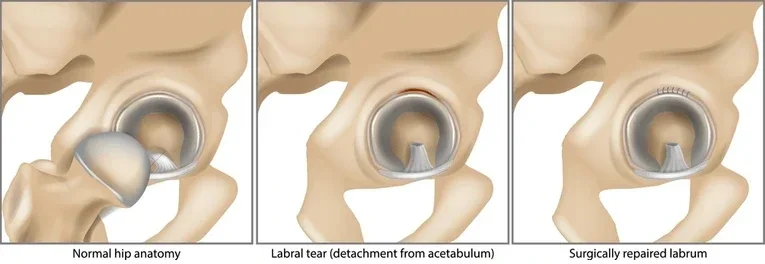
Surgical procedures commonly include labral repair, sometimes combined with reshaping of bony structures to reduce ongoing impingement.
Rehabilitation After Surgery
Post-operative rehab is critical and should be staged carefully.
Early phases prioritise protection and movement control. Strength and loading are gradually progressed before sport-specific drills are introduced.
Return to sport is guided by objective strength, control, and capacity measures rather than time alone. Most athletes return between four and six months, though this varies based on sport and individual response.
Key Takeaways for Athletes
Persistent hip or groin pain is not something to push through indefinitely
Labral tears are common but manageable with the right approach
Imaging findings alone do not dictate treatment
Rehabilitation plays a central role whether surgery is required or not
Early assessment and appropriate load management improve long-term outcomes
If hip pain is limiting your training or performance, a thorough assessment can clarify what is driving your symptoms and help map out a clear plan forward.
When to See a Physio
If hip or groin pain is starting to linger, limit your training, or change how you move, it is worth having it properly assessed sooner rather than later.
Early intervention can help identify whether your symptoms are coming from the labrum, surrounding muscles, or underlying hip structure, and more importantly, what can be done to manage it without unnecessarily shutting down your training.
At SurfEdge Sports Physiotherapy, we work closely with athletes to:
Identify the true driver of hip pain
Assess how load, strength, and movement are contributing
Build a clear rehabilitation plan that fits your sport and season
Guide safe progression back to full training and competition
If you are dealing with ongoing hip or groin pain, or have been told you have a labral tear and are unsure what that means for your sport, booking an assessment is the first step to getting clarity and moving forward with confidence.
Book an appointment or get in touch to discuss whether a tailored rehab approach is right for you.